Reflexive thematic analysis guide
How to Go From Codes to Themes in Reflexive Thematic Analysis (Braun and Clarke, Phase 3)
You have finished coding. There are 60, 90, maybe 200 codes in a document, and the next instruction in every guide is “search for themes”. Nobody shows what that looks like on the page. In Braun and Clarke's reflexive thematic analysis this is the step where most people stall, partly because it is the first one that cannot be done by following rules. This guide takes one invented study from 32 codes down to 4 themes and shows the decisions along the way, including the codes that were merged, the ones kept apart, and the one that was dropped.
How do I go from codes to themes?
You do not sort codes into piles by subject. You look for the central idea that several codes share, write it as a sentence, and test it against the data. In six moves:
- Tidy the codes. Merge true duplicates, keep look-alikes apart.
- Cluster by meaning. Group codes that say something about the same underlying thing, not codes about the same subject.
- Write the central idea. Put each cluster's idea in one sentence.
- Test each cluster. Run four checks, then reread the extracts.
- Place the leftovers. Promote, fold in, park or drop what does not fit.
- Draw a thematic map. See how the themes relate, then expect to revise.
Phase 3 of Braun and Clarke's six phases. Moving back to recode is normal, not a sign you got something wrong.
Why this phase feels so hard in reflexive thematic analysis
Two things make the move from codes to themes feel harder than it needs to.
The first is the name. In the 2006 paper the phases are “generating initial codes” and “searching for themes”, which sounds as if themes are sitting in the data waiting to be found. Braun and Clarke have since rejected that reading. Their view is that themes do not emerge from the data; the researcher builds them, and the data, the context and the researcher all shape the result (see their FAQ on thematicanalysis.net). Later versions of the phase list relabel this step as generating initial themes, which says what it is: an act of construction. Our guide to Braun and Clarke's thematic analysis covers all six phases, and reflexivity in thematic analysis explains why your own position is part of the method.
The second is that no procedure produces the answer. Counting codes, building a word cloud or sorting alphabetically will not give you themes. What you need is a judgement about shared meaning, and a judgement is hard to start when you are tired and looking at a long list. The way in is a small change of activity: stop sorting codes and start writing sentences. Everything below is a way of doing that in a controlled order.
The worked example
The study below is invented for illustration and does not come from real participants. It is eight interviews with teachers in their first or second year. The research question is what shapes early-career teachers' thinking about whether to stay in teaching? The codes were made inductively, read by read, in phase 2. You are at the point of holding 36 codes and wondering what to do with them. If you need to revisit how those codes were made, our guide to coding interview transcripts covers it.
Step 1: Tidy the codes
Start by merging codes that are the same thing under two names. This happens because you coded across several sessions and named the same idea differently each time. The test is practical: if the two labels would collect the same extracts, and you would give the same one-line summary for both, merge them.
| Before | After | Why merge |
|---|---|---|
| PLANNING UNTIL MIDNIGHT + PLANNING UNTIL 1AM | PLANNING LATE AT NIGHT | Same extracts, same meaning, only the clock time differs |
| COUNTING DAYS TO HALF TERM + COUNTING DAYS TO HOLIDAYS | COUNTING DAYS TO HOLIDAYS | Same behaviour described twice |
| TOLD TO JUST COPE + TOLD IT GETS EASIER | TOLD TO JUST COPE | Both are a colleague brushing off a worry |
| PUPIL THANK-YOU NOTE + PUPIL MADE A CARD | PUPIL THANK-YOU NOTE | Both are a pupil showing appreciation in writing |
Four merges take 36 codes to 32. Now the harder part: two pairs that look like candidates and should stay apart.
- MENTOR TOO BUSY TO OBSERVE and MENTOR GAVE ONE USEFUL TIP share a subject, but they point in opposite directions. The contrast is the interesting part, so both stay.
- FEAR OF BEING JUDGED and HIDING MISTAKES FROM COLLEAGUES are a feeling and an action. They will probably end up in the same theme, but they are different observations and the later argument may need both.
Do not tidy too hard. Merging early is how a useful distinction gets lost, and you can always merge later when the clusters show you what matters.
Step 2: Cluster by meaning, not by subject
The usual first attempt is to sort by subject. For this study that would give six buckets:
Workload · Mentoring · Behaviour · Pay · Wellbeing · Motivation
It looks tidy and it is not yet analysis. These are topic headings you could have written before collecting any data, and they describe what teachers talked about, not what the talk means. They also fit the codes badly. DREAD OF THE INSPECTION could go under Wellbeing, Behaviour or Mentoring. BEHAVIOUR LOG TAKES 40 MINUTES belongs to Workload and Behaviour at once. HIDING MISTAKES FROM COLLEAGUES fits nowhere. When codes keep refusing to sit in a bucket, the buckets are the wrong shape. Our guide to codes versus themes explains why a subject heading is not a theme.
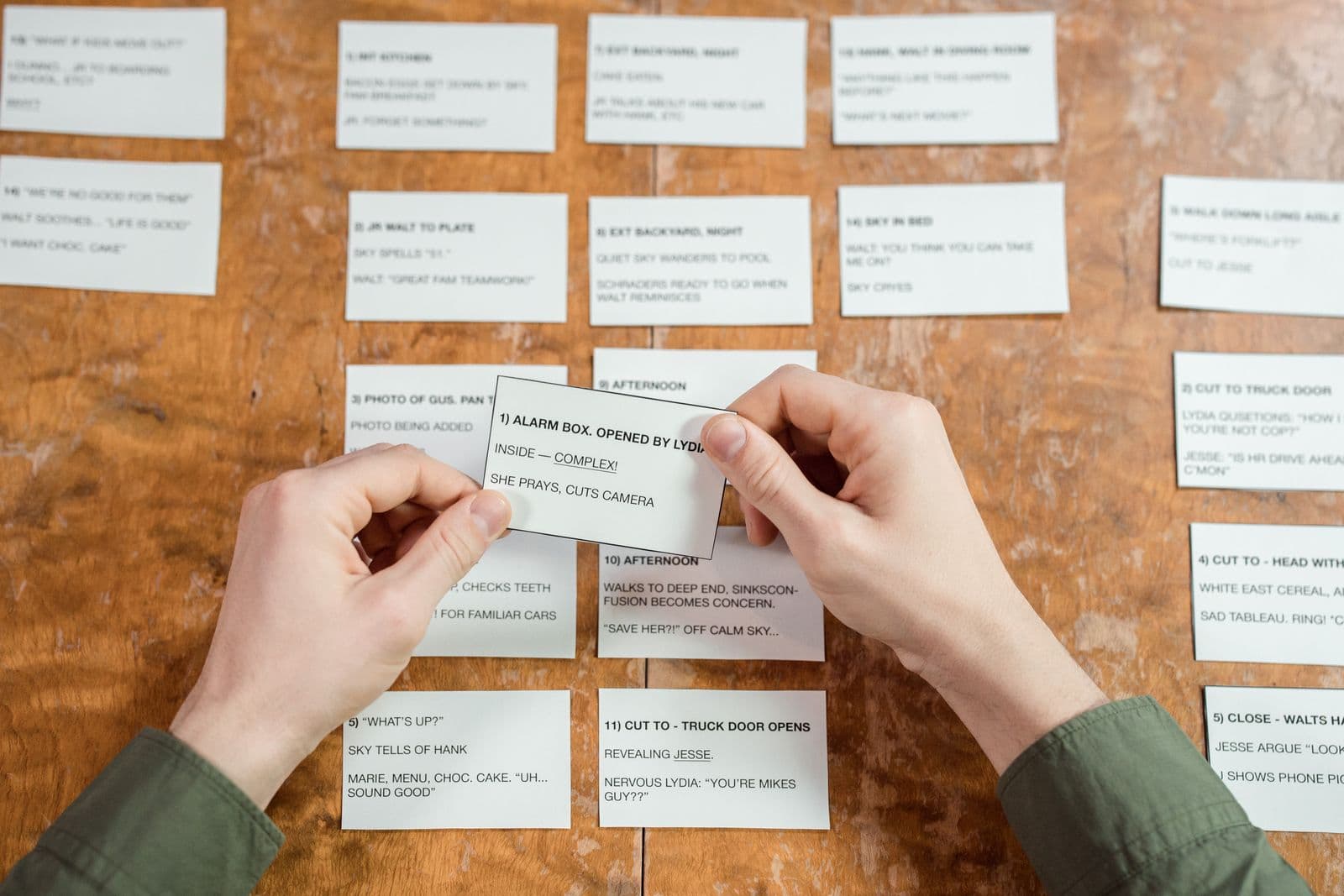
To cluster by meaning, work with the codes as separate items (one per card or per spreadsheet row, with a short extract beside each). Ask of each pair a different question. Not “are these about the same subject?” but “do these two say something about the same underlying thing?” Start with the codes that already feel connected and let the groups grow from there. Braun and Clarke describe this as processes of clustering and meaning-mapping.
Applied to the example, four clusters formed. One surprise: FRIENDS OUTSIDE TEACHING EARN MORE, PAY FROZEN WHILE RENT RISES and STUDENT LOAN REPAYMENTS made a tidy “money” cluster, but it kept failing the next step. More on that below.
Step 3: Write each cluster's central idea as a sentence
This is the step that turns a pile into a theme. For each cluster, complete the sentence: this theme says that ___, which matters for the research question because ___. In Braun and Clarke's terms you are looking for the central organising concept that holds the codes together as one pattern of shared meaning (Braun and Clarke, 2019; 2021).
Here is where the example ended up. The working names are short so you can see the pieces. The sentence is what makes each one a theme.
Theme 1 · 8 codes
Coping alone and hiding it
Central idea: Support exists on paper but feels conditional, so beginners hide their struggles and cope alone.
TOLD TO JUST COPEMENTOR TOO BUSY TO OBSERVEMENTOR GAVE ONE USEFUL TIPPRAISE ONLY ONCE FROM HEAD OF DEPARTMENTFEEDBACK ONLY WHEN SOMETHING GOES WRONGFEAR OF BEING JUDGEDHIDING MISTAKES FROM COLLEAGUESCOMPARING SELF TO TEACHERS WHO MAKE IT LOOK EASY
Theme 2 · 8 codes
A job with no edges
Central idea: Work follows teachers home, and the bill is paid in sleep and relationships.
MARKING SPILLS INTO EVENINGS AND WEEKENDSPLANNING LATE AT NIGHTPARENT EMAILS AT NIGHTCOVER LESSONS WITHOUT NOTICESUNDAY DREADNOT SLEEPING WELLCANCELLING PLANS WITH FRIENDSPARTNER WORRIED
Theme 3 · 6 codes
Authority nobody owns
Central idea: Nobody quite owns authority in the school, so each new teacher has to build it alone, lesson by lesson.
LEARNING THE BEHAVIOUR POLICY BY TRIALPOLICY APPLIED DIFFERENTLY BY DIFFERENT STAFFSENIOR LEADERS ABSENT FROM CORRIDORSPUPILS TESTING NEW TEACHERSBEHAVIOUR LOG TAKES 40 MINUTESDREAD OF THE INSPECTION
Theme 4 · 9 codes
Staying as a running calculation
Central idea: Staying is a running calculation, with moments of meaning on one side and pay and exhaustion on the other.
FRIENDS OUTSIDE TEACHING EARN MOREPAY FROZEN WHILE RENT RISESSTUDENT LOAN REPAYMENTSTHOUGHT OF LEAVING AFTER CHRISTMASCOUNTING DAYS TO HOLIDAYSKEEPING GOING FOR ONE CLASSPUPIL THANK-YOU NOTEMOMENTS OF REAL JOYWANTED TO TEACH SINCE CHILDHOOD
Notice that every central idea makes a claim someone could argue with. “Workload” cannot be argued with. “The job has no edges, and the bill is paid in sleep and relationships” can. That is the difference between a topic and a theme.
Step 4: Test each theme before you trust it
A first sentence is a draft. Run each candidate theme through four checks, then go back to the extracts.
| Check | The question it asks | In the example |
|---|---|---|
| One-sentence test | Can I state a claim about the data, not just a subject? | “Money” failed: money is a subject. “Staying is a running calculation” passed. |
| Same-idea test | Are the codes inside about one idea, or just one area? | WANTED TO TEACH SINCE CHILDHOOD and PAY FROZEN WHILE RENT RISES look unrelated, but both feed the calculation of whether to stay. |
| Distinctness test | Could two themes be written as one sentence without losing anything? | Themes 1 and 3 both involve being new and alone. One is about support and concealment, the other about authority. Different ideas, so both stay. |
| Research question test | Does it help answer what I set out to ask? | CHOSE SCHOOL FOR ITS LOCATION says nothing about staying or leaving. |
Then reread the extracts under each theme with the sentence in front of you. If you keep finding passages that do not fit, the sentence is wrong or the cluster is two ideas. In the example, one borderline case settled this way: DREAD OF THE INSPECTION could sit in Theme 1 (being judged) or Theme 3 (authority). Rereading the extracts, participants described the inspection as the moment someone might find out that nobody was in charge, so it went to Theme 3.
Frequency is not one of the checks. In reflexive thematic analysis a theme earns its place by what it adds to the answer, not by how many participants mentioned it. Our guide to thematic analysis for a dissertation shows how to explain that choice in a methods chapter.
Step 5: Place the leftovers
Some codes will not sit in any cluster. There are four things you can do with them, and the example used three.
- Fold in. The three money codes could not stand as a theme (what would it say about money?) but they are the cost side of the staying calculation, so they joined Theme 4.
- Park. WANTED TO TEACH SINCE CHILDHOOD had no obvious home, so it went to a parking list. At review it turned out to belong with the meaning side of Theme 4.
- Drop. CHOSE SCHOOL FOR ITS LOCATION was also parked, and stayed there. It does not help answer the research question, so it left the analysis. Drop at the end, not the beginning, so you can change your mind.
- Promote. Braun and Clarke note that a code with a lot of substance can become a theme in its own right. None did here, but if one code had collected extracts from every interview with a clear idea behind them, promotion would be the answer.
Step 6: Draw a thematic map and go back to the data
Braun and Clarke recommend thematic maps during theme development. Draw yours by hand first: four boxes, with arrows only where you can say what the relationship is. In the example, Theme 1 and Theme 3 feed Theme 2 (the effort of coping alone and of building authority is part of why work spills over), and all three feed the calculation in Theme 4. A map that is only boxes with no arrows usually means the themes are still a list.
What you have now is a set of candidate themes, not final ones. Phase 4 is where you check them against the whole dataset, and your themes will probably shift. If you want a draft map to react to, our thematic map generator builds one from your own data.
Merge, keep or drop? A quick reference
| Situation | Do this |
|---|---|
| Two codes collect the same extracts and mean the same thing | Merge. Keep the clearer label. |
| Same subject, different stance, cause or consequence | Keep apart. The contrast may be the finding. |
| A feeling and an action that go together | Keep both and cluster them. |
| One code with many extracts and a clear idea behind it | Consider promoting it to a theme. |
| A tidy topic cluster that fails the one-sentence test | Fold in to a theme it belongs to, or rework the cluster. |
| Interesting, but no link to the research question | Park it, then drop it at the end if it still has no home. |
| Only one participant says it | Ask whether it sharpens or contradicts a theme before dropping it. |
Do you need categories first? And what about subthemes?
Many students ask whether they should group codes into categories before looking for themes. In reflexive thematic analysis you do not have to. The unit of analysis is the theme, defined by a central organising concept, and there is no required layer between codes and themes (categories belong more to approaches such as grounded theory and qualitative content analysis; see thematic analysis frameworks). A temporary folder of related codes can still help you work. The only rule is that you rename it as a sentence before you call it a theme.
Subthemes are for a large theme with distinct facets. Theme 2 in the example could split into a body strand (sleep, dread) and a relationships strand (cancelled plans, partner), if the write-up needed it. Each subtheme should still have its own idea. Do not use subthemes to avoid deciding which codes belong where.
How many codes is too many, and how many themes should you have?
A long list of codes after phase 2 is normal. Coding generously is how you avoid missing things, and the list is meant to be reduced in this phase. There is no number of codes that signals a problem.
For themes, Braun and Clarke give no formula. It depends on the data, the research question and how long the report is. Their guidance is that around two to six themes (and subthemes) is about right for a single article or a Masters dissertation, and that a broad overview will carry more themes with less depth each. If you have a dozen thin themes, some are probably still topic summaries or belong together. The example has four, from eight interviews.
If you chose inductive coding and now feel stuck
Being stuck here is common, and it is not evidence that you chose the wrong approach. Inductive coding means the codes came from the data rather than from a pre-set framework. It does not mean the themes will arrive on their own. Whatever your approach, the grouping step takes judgement.
Braun and Clarke say thematic coding can involve either or both inductive and deductive coding, and that coding can evolve as the analysis does. You do not need to restart as a deductive study to get unstuck, and your phase 2 work is not wasted. If your supervisor has mostly worked deductively, give them something concrete to react to: the table of themes, each with its central idea sentence and two or three supporting extracts. Ask them to challenge the sentences. That is a conversation any experienced qualitative researcher can have, whatever method they usually use. Our comparison of inductive and deductive coding sets out what each approach commits you to.
Common mistakes
- Sorting by subject. If your headings could have been written before the interviews, they are topics.
- Naming themes with one word. “Support” is a label, while a theme says something about support.
- Forcing every code in. Some codes should go, and a theme that exists only to house leftovers is not a theme.
- Treating frequency as importance. One participant's sharp observation can anchor a theme, and a topic everyone mentioned can still say nothing.
- Merging early, which loses distinctions the clusters would have shown you mattered, or skipping the reread, so the theme lives on the card but not in the extracts.
And one more that is easy to miss: waiting until you feel certain. Candidate themes are provisional by design. Make a version, test it, revise it.
A second opinion on your grouping
If you have coded by hand and the clusters still will not settle, one useful move is to look at a different cut of the same data and compare. That is where software can help without taking over the interpretation.
thematicanalysis.ai runs reflexive thematic analysis by default. Give it your transcripts or survey responses and it returns codes, each with a verbatim quote checked against the text you uploaded, and named themes that list the participants behind them. It works from your transcripts or responses, and you can load your own codebook so it codes with your codes rather than its own. It does not reorganise a code list on its own, so treat it as a comparison rather than a shortcut past your own coding. Where its clusters match yours, you may be on firm ground. Where they differ, go back to the extracts and decide who is right.
If the draft misses, there is a box that asks what the themes should capture instead. Tell it, for example, to merge two that overlap or split one that is too broad, and the themes are rebuilt from the same codes. You can also rename, merge or remove themes yourself, and every code links back to the passage it came from. The judgement calls in this guide stay yours. To judge any tool for this kind of work, including ours, use the checklist for reflexive thematic analysis software. If you are weighing whether AI belongs in a reflexive analysis at all, our guide to AI qualitative coding sets out the debate, and reporting AI-assisted analysis has wording for your methods section.
Paste a few interviews below to see what grouping it proposes for your data. Keep the speaker labels in.
Frequently asked questions
How do you go from codes to themes in thematic analysis?
Tidy your codes by merging true duplicates, then cluster the ones that share an underlying meaning (not just a subject). For each cluster, write one sentence stating the central idea that holds the codes together, then test it: does it say something, is it distinct from the other themes, and does it help answer your research question? Codes that fit nowhere can be promoted, folded into another theme, parked or dropped. Expect to go back and forth. Braun and Clarke describe the process as recursive.
How do I organise a large number of initial codes?
Put every code on its own card or spreadsheet row, with one short extract beside it. Merge only the codes that would collect the same extracts and mean the same thing. Then move codes next to each other when they say something about the same underlying thing. A temporary folder name is fine while you work, but rename it as a sentence before you call it a theme. A large pile of codes at this stage is normal and does not mean phase 2 went wrong.
How do I decide whether to merge two codes or keep them separate?
Merge when the two labels would collect the same extracts and you would give the same one-line summary for both. Keep them apart when they share a subject but differ in stance, cause or consequence. For example, 'mentor too busy to observe' and 'mentor gave one useful tip' are both about mentoring, but they point in opposite directions, and the contrast is worth keeping.
Do I need categories before themes in reflexive thematic analysis?
No. Braun and Clarke's reflexive thematic analysis does not require a category layer between codes and themes. The unit of analysis is the theme, built around a central organising concept. A temporary grouping of codes can help you work, but a topic heading is not a theme until you can state the idea behind it in a sentence.
How do I know if a group of codes is a theme or just related ideas?
Try to complete the sentence 'This theme says that ___.' If the best you can write is a subject (money, workload, support), you have a topic summary. If you can state a claim about the data that someone could disagree with, you have the start of a theme. Then check that the codes inside it are about one idea, that the theme is distinct from the others, and that it helps answer your research question.
How many themes should I have?
There is no formula. Braun and Clarke's own guidance says it depends on the data, the research question and the length of the report, and that around two to six themes (and subthemes) is about right for a single article or a Masters dissertation. A dozen thin themes usually means some are still topic summaries or should be merged.
Can I go back to coding after I start building themes?
Yes. Moving between phases is part of the method. If a cluster will not hold together, the fix is often to return to the extracts, recode a few passages, or split a code that was doing two jobs. Coding can evolve as the analysis does.
I used an inductive approach and my supervisor only knows deductive. Do I need to switch?
Not because of that. Braun and Clarke note that thematic coding can involve either or both inductive and deductive coding, and your phase 2 work is not wasted. What matters is that your approach is coherent and that you can explain it. Bring your supervisor the codes-to-themes table with extracts and ask them to challenge the central idea sentences, which is a conversation any experienced researcher can have. Switching to a fully deductive design would mean building a framework from theory and recoding, which is a different study.
How this guide was made
Written by the thematicanalysis.ai team. We used AI to help research and draft it, then checked the method claims against the sources listed below and edited the text. The teacher interview study, its codes and its themes are invented for illustration and do not come from real participants. The description of our tool reflects how it worked when this guide was published.
References
- Braun, V. and Clarke, V. (2006). Using thematic analysis in psychology. Qualitative Research in Psychology, 3(2), pp. 77–101. doi:10.1191/1478088706qp063oa
- Braun, V. and Clarke, V. (2019). Reflecting on reflexive thematic analysis. Qualitative Research in Sport, Exercise and Health, 11(4), pp. 589–597. doi:10.1080/2159676X.2019.1628806
- Braun, V. and Clarke, V. (2021). One size fits all? What counts as quality practice in (reflexive) thematic analysis? Qualitative Research in Psychology, 18(3), pp. 328–352. doi:10.1080/14780887.2020.1769238
- Braun, V. and Clarke, V. (2022). Thematic Analysis: A Practical Guide. London: SAGE.
- Braun, V. and Clarke, V. Thematic analysis: frequently asked questions. University of Auckland. thematicanalysis.net/faqs